Introduction to Network Alignment
Network alignment (NA) aims to find correspondences between the nodes of two networks (or graphs). It plays a crucial role in domains such as social network analysis, bioinformatics, and knowledge graph fusion.
Problem Definition
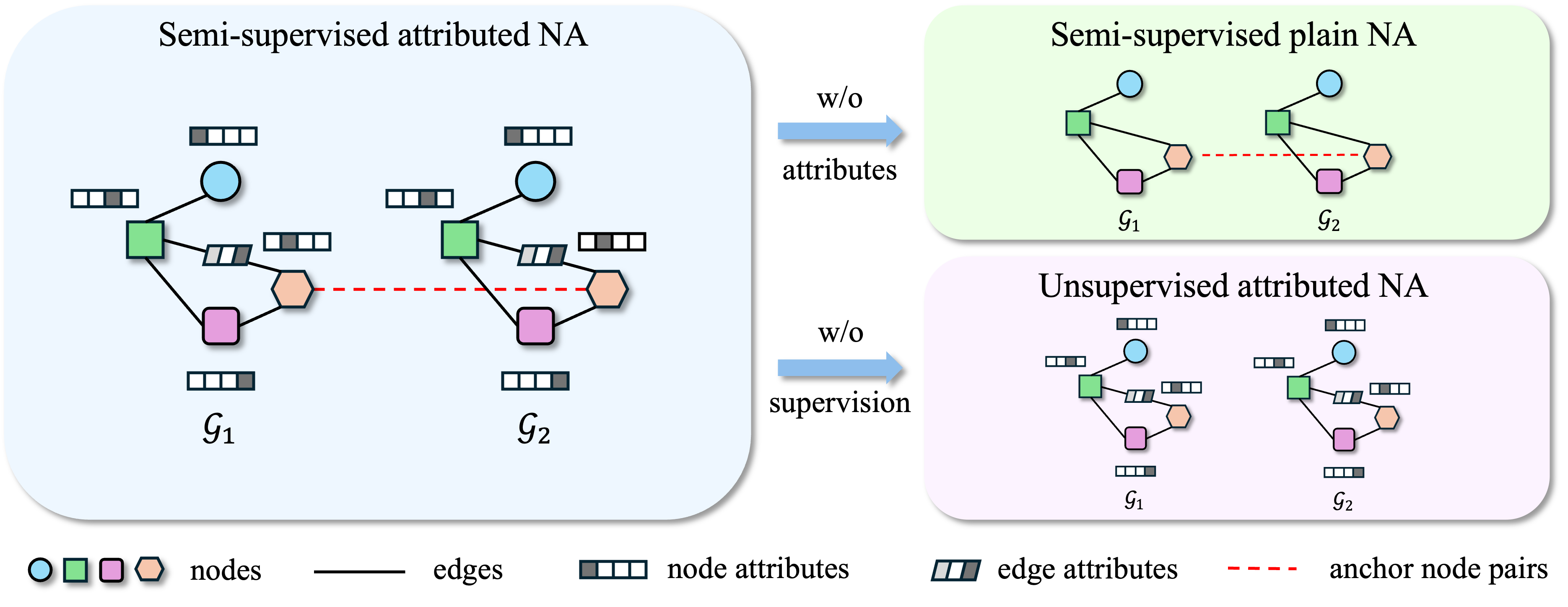
Formally, given two input graphs \(\mathcal{G}_1 = \{\mathcal{V}_1, \mathbf{A}_1, \mathbf{X}_1, \mathbf{E}_1\}\), \(\mathcal{G}_2 = \{\mathcal{V}_2, \mathbf{A}_2, \mathbf{X}_2, \mathbf{E}_2\}\) where:
\(\mathcal{V}_1, \mathcal{V}_2\) are node sets,
\(\mathbf{A}_1, \mathbf{A}_2\) are graph adjacency matrices,
\(\mathbf{X}_1, \mathbf{X}_2\) are node attribute matrics,
\(\mathbf{E}_1, \mathbf{E}_2\) are edge attribute matrices,
and a set of anchor links \(\mathcal{L} = \{(x, y) \mid x \in \mathcal{V}_1, y \in \mathcal{V}_2\}\), the goal of NA tasks is to learn an alignment matrix \(\mathbf{S}\) such that \(\mathbf{S}(x, y)\) reflects the alignment likelihood between node \(x\) and node \(y\).
Variants of NA include:
Plain NA: Only graph topology is available (i.e., no \(\mathbf{X}_i\) or \(\mathbf{E}_i\))
Attributed NA: Node and/or edge attributes are available (i.e., \(\mathbf{X}_i\) and/or \(\mathbf{E}_i\) are non-empty)
Supervised NA: Anchor links are provided (i.e., \(|\mathcal{L}| > 0\))
Unsupervised NA: No anchor links are available (i.e., \(|\mathcal{L}| = 0\))
Categories of Network Alignment Methods
Network alignment methods can be broadly categorized into the following three classes:
Consistency-based Methods These methods align nodes by preserving structural or attribute consistency between neighborhoods. Examples: IsoRank, FINAL
Embedding-based Methods These approaches learn node embeddings in a shared space and align based on similarity. Examples: BRIGHT, NeXtAlign, NetTrans
Optimal Transport (OT)-based Methods These methods formulate alignment as a transport problem over node distributions with learnable cost functions. Examples: PARROT, JOENA, SLOTAlign
Common Applications
🧑💻 Social network recommendation: Align user identities across different social platforms for personalized recommendations.
📞 Communication network alignment : Align communication patterns between different networks to identify similar users or communities.
✍️ Publication network alignment : Align research papers or authors for disambiguation.
🧬 Biological network alignment : Identify orthologous proteins or genes between species.
📚 Knowledge graph fusion : Merge different knowledge bases into a unified one.
🏗️ Infrastructure network alignment : Align different infrastructure networks (e.g., transportation, utilities) for better resource management.